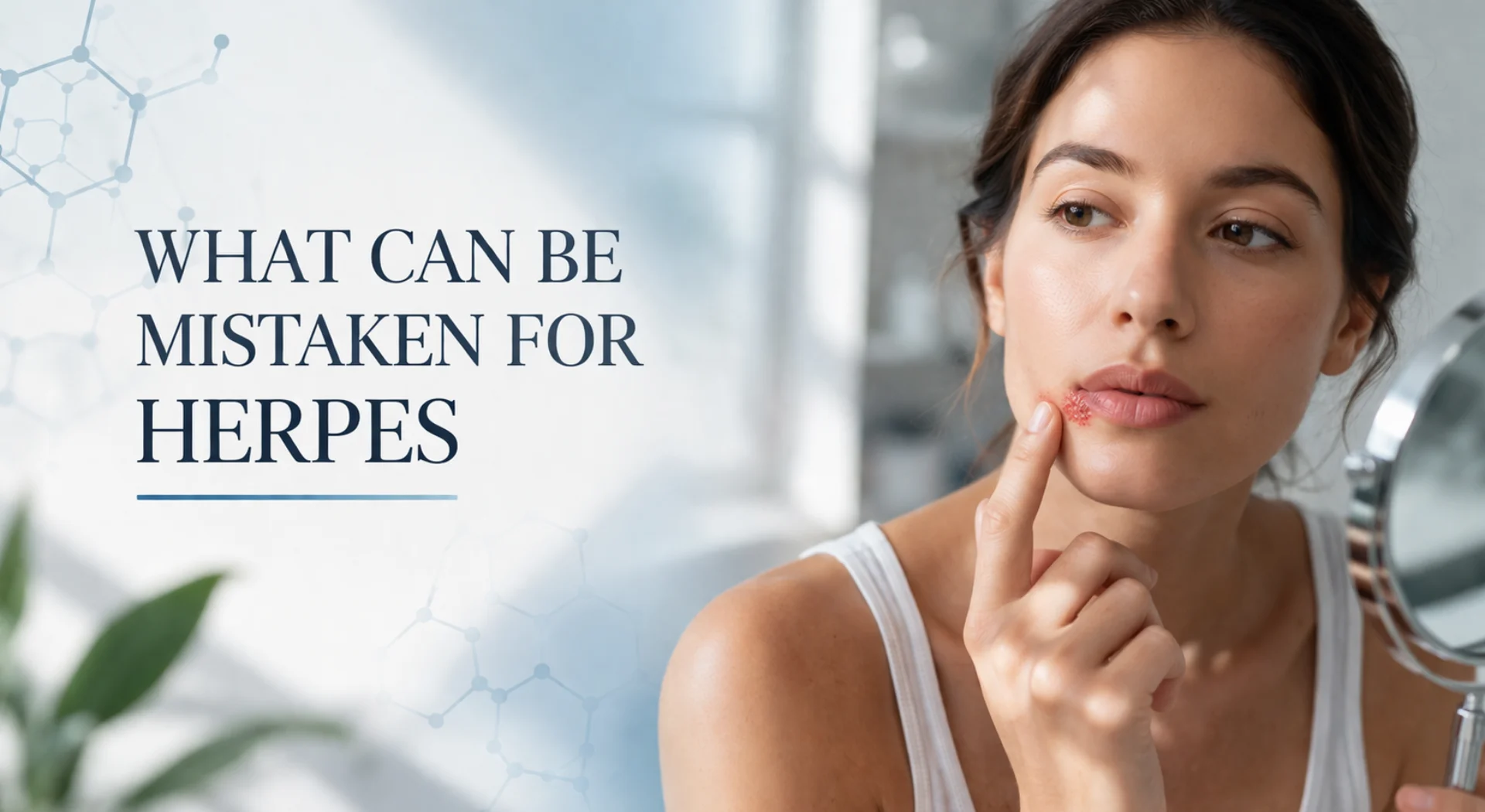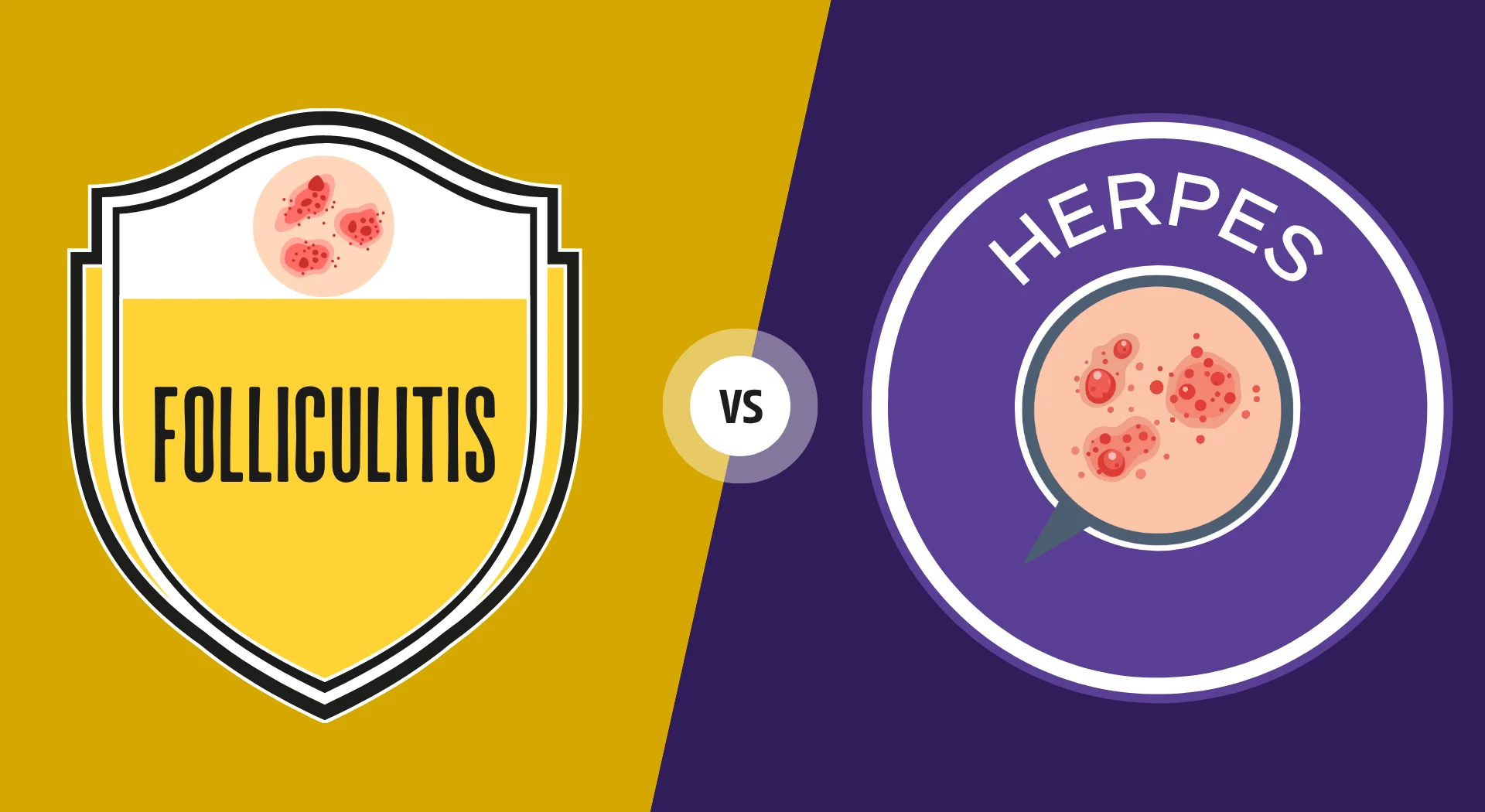
Folliculitis and herpes may look similar at first glance, but they are fundamentally different conditions. Folliculitis is a bacterial or irritation-based inflammation of hair follicles, while herpes is a viral infection caused by the herpes simplex virus (HSV-1 or HSV-2).
The key difference lies in lesion structure, progression, pain pattern, and recurrence. Herpes typically presents as grouped fluid-filled blisters that progress into ulcers, while folliculitis appears as isolated bumps centered around hair follicles, often containing pus rather than clear fluid.
Why Folliculitis Is Commonly Confused with Herpes
From a clinical observation standpoint, folliculitis is one of the most frequently misidentified conditions when individuals suspect herpes. This confusion arises because both conditions can appear in similar areas such as the genital region, inner thighs, or areas exposed to friction and moisture.
The confusion increases due to overlapping visual features such as redness, bumps, and mild discomfort. However, when examined in detail, the biological behavior of these two conditions is entirely different.
The mistake often occurs when people focus only on appearance rather than progression and underlying cause.
Read Also: Can You Get Herpes from a Toilet Seat? Exact Survival Time of HSV
What Is Folliculitis: A Medical Explanation
Folliculitis is an inflammation of the hair follicle, usually caused by bacterial infection, friction, or blockage.
Common causes include:
- Shaving or hair removal
- Tight clothing causing friction
- Sweat and moisture buildup
- Bacterial growth, especially Staphylococcus species
Symptoms typically include:
- Small red or white bumps
- Pus-filled lesions
- Mild itching or irritation
- Localized inflammation around hair follicles
These bumps are usually centered around a hair follicle, which is one of the most important identifying features.
What Is Herpes: A Virological Perspective
Herpes simplex virus is a viral infection that affects skin and mucous membranes. It behaves very differently from folliculitis because it is not related to hair follicles.
Herpes symptoms follow a distinct pattern:
- Initial tingling or burning sensation
- Formation of clustered fluid-filled blisters
- Blisters rupture into shallow ulcers
- Healing phase followed by possible recurrence
The virus remains dormant in nerve cells and can reactivate periodically.
Core Differences Between Folliculitis and Herpes
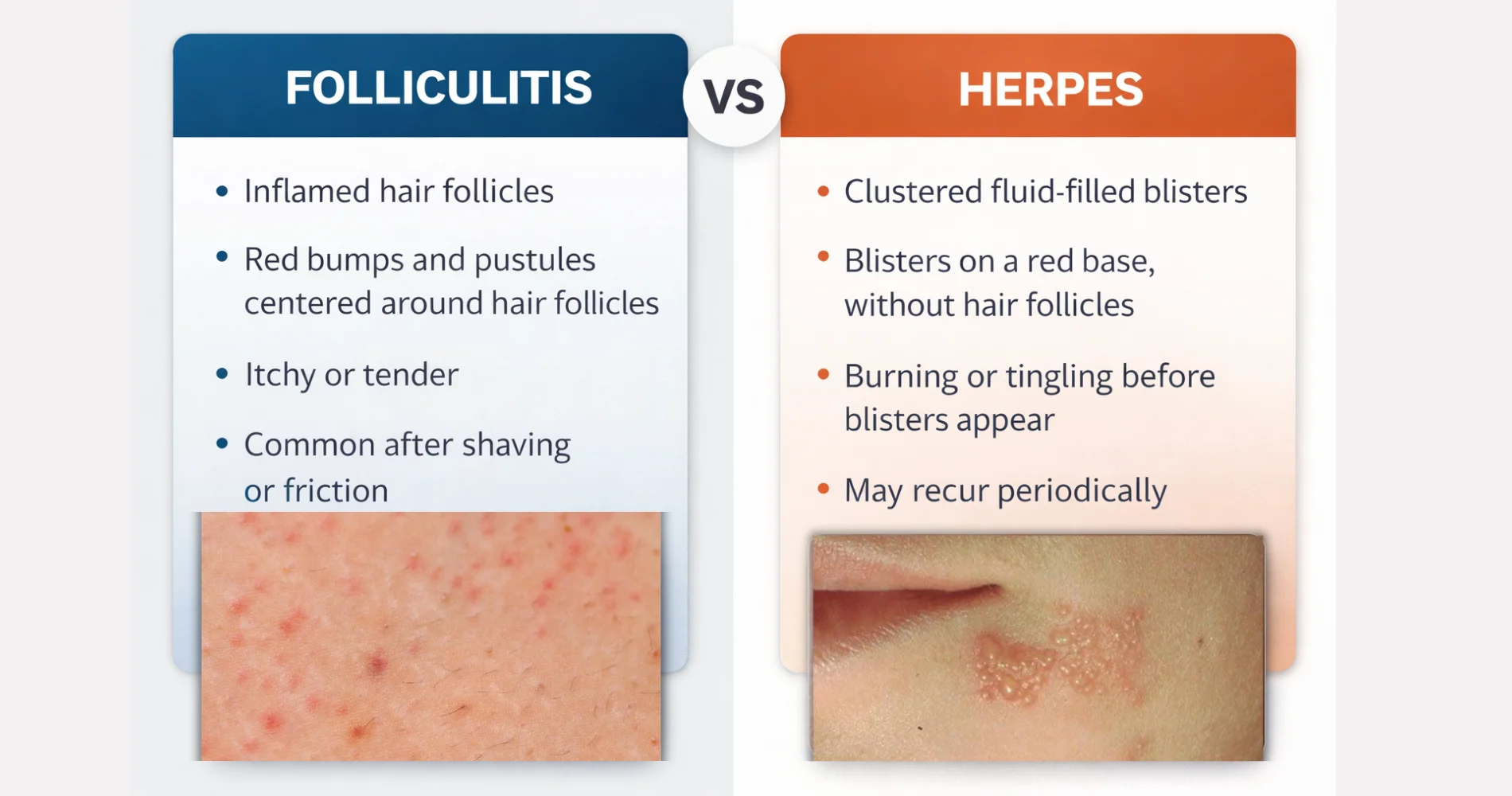
To clearly understand the distinction, it is important to compare both conditions across multiple clinical factors.
1. Cause and Origin
- Folliculitis is caused by bacteria, irritation, or mechanical factors
- Herpes is caused by a virus that enters nerve cells and remains in the body
2. Appearance of Lesions
Folliculitis:
- Individual bumps
- Often centered around hair follicles
- May contain pus
- Not grouped in clusters
Herpes:
- Clustered blisters
- Filled with clear fluid initially
- Progress into open sores
- Not centered around hair follicles
3. Pain and Sensation
Folliculitis:
- Mild discomfort or itching
- Usually not deeply painful
Herpes:
- Burning, tingling sensation before outbreak
- Moderate to severe pain during outbreak
4. Progression Pattern
Folliculitis:
- Appears as bumps
- May develop into small pustules
- Heals without forming ulcers
Herpes:
- Starts as blisters
- Blisters rupture
- Forms ulcers before healing
5. Recurrence Behavior
Folliculitis:
- Does not follow a predictable recurrence pattern
- Usually linked to external triggers like shaving
Herpes:
- Recurs in the same area
- Triggered by stress, immunity, or internal factors
Folliculitis Versus Herpes
| Feature | Folliculitis | Herpes |
|---|---|---|
| Cause | Bacterial or irritation | Viral (HSV) |
| Lesion Type | Pus-filled bumps | Fluid-filled blisters |
| Pattern | Isolated | Clustered |
| Pain | Mild | Moderate to severe |
| Recurrence | No consistent pattern | Recurring outbreaks |
| Location | Hair follicles | Skin and mucous membranes |
How to Tell If It Is Folliculitis or Herpes
To differentiate accurately, focus on these clinical indicators:
Signs more consistent with folliculitis:
- Bumps appear after shaving or friction
- Lesions are centered around hair
- Pus is present
- No blister to ulcer progression
Signs more consistent with herpes:
- Tingling sensation before lesions appear
- Grouped fluid-filled blisters
- Painful sores after rupture
- Recurring outbreaks in the same area
Why Misdiagnosis Happens So Often
From a research and behavioral perspective, misdiagnosis happens because people rely on incomplete information.
Common reasons include:
- Visual similarity in early stages
- Lack of understanding of lesion progression
- Anxiety leading to worst-case assumptions
- Online images that show extreme cases
Without understanding how each condition evolves over time, it becomes difficult to distinguish between them.
When to Seek Confirmation
It is important to consider proper evaluation when:
- Lesions are recurring
- Pain is significant
- Symptoms do not match typical folliculitis
- There is uncertainty about diagnosis
Clinical evaluation and testing can provide accurate answers.
Also Read: Celebrities With Herpes: Full List of Famous People With HSV, Rumors, and Confirmed Cases
Final Conclusion
Folliculitis and herpes may appear similar at first, but they differ fundamentally in cause, structure, progression, and recurrence. Folliculitis is a localized inflammation of hair follicles, often linked to external factors, while herpes is a viral infection with a distinct lifecycle and recurring pattern.
In clinical observation, a large number of suspected herpes cases are actually folliculitis or other minor skin conditions. Understanding the distinction removes unnecessary fear and allows for more accurate interpretation of symptoms.
Accurate identification depends on understanding these differences rather than relying on appearance alone.
Frequently Asked Questions (FAQ)
1) Folliculitis vs herpes how to tell?
Folliculitis presents as individual pus-filled bumps around hair follicles, while herpes appears as grouped fluid-filled blisters that turn into sores.
2) Can folliculitis look like herpes?
Yes, especially in early stages, but they differ in progression and structure.
3) Is folliculitis painful like herpes?
Folliculitis usually causes mild discomfort, while herpes can cause significant pain and burning.
4) How do I know if I have herpes or folliculitis?
Look for blister formation, clustering, and recurrence. These are key signs of herpes.