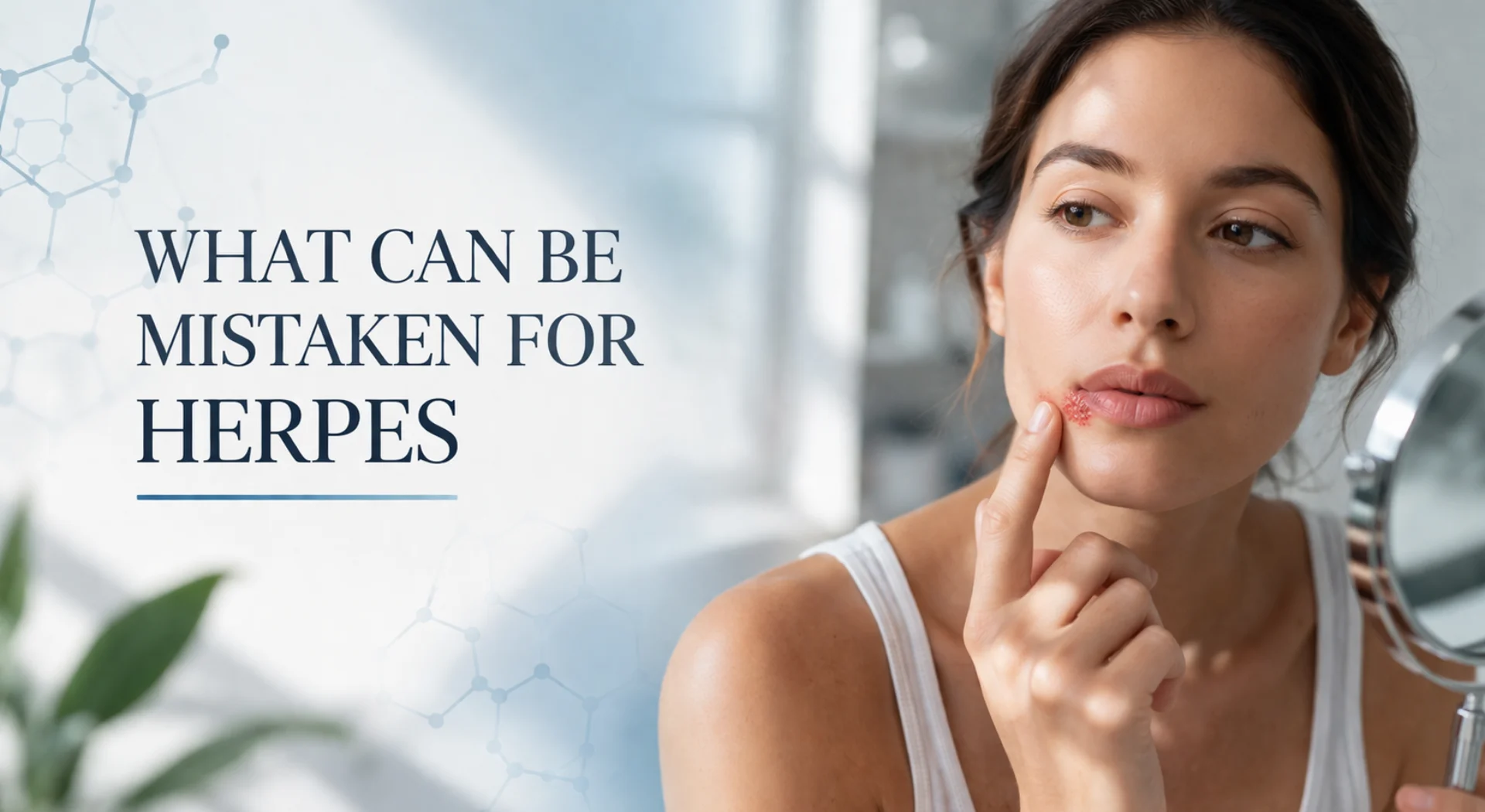
Several conditions can be mistaken for herpes, especially genital herpes or oral herpes. The most common ones include ingrown hair, folliculitis, yeast infection, contact dermatitis, syphilis, friction burns, bacterial infections, molluscum contagiosum, and aphthous ulcers. These conditions can create bumps, sores, redness, or irritation that closely resemble herpes symptoms, which is why misdiagnosis is very common.
However, while these conditions may look similar at first, they differ significantly in structure, progression, pain pattern, and recurrence behavior.
Why Herpes Is Commonly Misdiagnosed
From a clinical and observational standpoint, herpes is one of the most misunderstood skin conditions. The primary reason is that people tend to rely on visual similarity rather than biological behavior.
Herpes has a very specific progression pattern. It typically begins with tingling or burning, followed by the formation of small fluid-filled blisters. These blisters then rupture, forming shallow ulcers, and eventually heal over time. This cycle often repeats in the same area.
The problem is that many other conditions can mimic one or more stages of this cycle. For example, a red bump may resemble an early herpes lesion, while a skin crack or sore may resemble a healing ulcer. Without understanding the full progression, it becomes easy to assume herpes incorrectly.
Another major issue is that not all herpes cases look textbook. Some individuals experience mild or atypical symptoms, which further increases confusion.
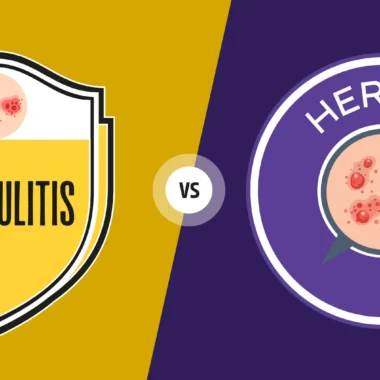
Read Also: Folliculitis vs Herpes: Key Differences, Symptoms, Pictures, and How to Tell Them Apart
What Can Be Mistaken for Herpes: Detailed Medical Breakdown
1. Ingrown Hair and Folliculitis
One of the most common conditions mistaken for herpes is ingrown hair or folliculitis. This is especially true in areas where hair removal is frequent, such as the genital region.
Folliculitis occurs when hair follicles become inflamed due to friction, shaving, or bacterial presence.
Key features include:
- Small red or white bumps around hair follicles
- Presence of pus rather than clear fluid
- Mild tenderness rather than deep pain
- Usually appears after shaving or friction
Important distinction:
- Herpes lesions are fluid-filled and often appear in clusters
- Folliculitis lesions are centered around hair follicles and do not form grouped blisters
2. Yeast Infection (Candidiasis)
Yeast infections are often confused with genital herpes, particularly in women.
Symptoms include:
- Intense itching and irritation
- Redness and inflammation
- Burning sensation, especially during urination
- Thick discharge in some cases
Why confusion happens:
- Severe irritation may cause small skin breaks or redness
- Burning sensation may feel similar to herpes
Key difference:
- Yeast infections do not produce fluid-filled blisters
- Symptoms are more widespread rather than localized clusters
3. Contact Dermatitis and Allergic Reactions
Contact dermatitis is a skin reaction caused by exposure to irritants such as soaps, detergents, condoms, lubricants, or fabrics.
Symptoms include:
- Red rash
- Itching or burning
- Small bumps or irritated skin patches
Triggers may include:
- New hygiene products
- Chemical exposure
- Tight or synthetic clothing
Key difference:
- Dermatitis does not form true vesicles that rupture into ulcers
- Symptoms improve when the irritant is removed
4. Syphilis (Primary Stage)
Syphilis is one of the most critical conditions that can be mistaken for herpes, and proper differentiation is essential.
Primary syphilis presents as:
- A single round ulcer known as a chancre
- Firm edges with a clean base
- Usually painless
Key difference:
- Herpes lesions are usually painful and occur in clusters
- Syphilis typically presents as a single painless sore
5. Molluscum Contagiosum
This is a viral skin condition that can resemble herpes, especially in the genital area.
Symptoms include:
- Small, raised, flesh-colored bumps
- Central indentation or dimple
- Usually painless
Key difference:
- Lesions are firm and solid, not fluid-filled
- They do not rupture into ulcers
6. Bacterial Skin Infections
Bacterial infections such as impetigo or localized abscesses can sometimes resemble herpes lesions.
Characteristics include:
- Pus-filled sores
- Yellow crust formation
- Localized swelling
Key difference:
- Herpes lesions start with clear fluid
- Bacterial infections often involve pus and crusting
7. Friction Burns and Mechanical Irritation
Friction from physical activity or sexual contact can cause skin damage that resembles herpes.
Symptoms include:
- Redness and irritation
- Surface-level sores
- Burning sensation
Key difference:
- These do not develop into fluid-filled blisters
- They heal quickly once friction stops
8. Aphthous Ulcers (Canker Sores)
In oral cases, herpes is often confused with canker sores.
Characteristics:
- Small, round ulcers inside the mouth
- White or yellow center
- Painful but not caused by HSV
Key difference:
- Oral herpes usually appears on the lips or outside the mouth
- Canker sores occur inside the mouth and are not contagious
Comparison Table for Clear Understanding
| Condition | Appearance | Pain Level | Fluid Filled | Recurrence | Key Indicator |
|---|---|---|---|---|---|
| Herpes | Clustered blisters | High | Yes | Yes | Tingling before outbreak |
| Ingrown Hair | Single bump | Low | No | No | Hair follicle center |
| Yeast Infection | Red rash | Medium | No | Sometimes | Itching dominant |
| Syphilis | Single ulcer | Low | No | No | Painless sore |
| Molluscum | Raised bumps | None | No | Yes | Central dimple |
| Bacterial Infection | Pus sores | Medium | No | No | Yellow crust |
| Friction Burn | Red patches | Mild | No | No | Triggered by friction |
Key Clinical Signs That Strongly Suggest Herpes
To identify herpes more accurately, focus on patterns rather than appearance alone.
Common herpes indicators include:
- Clustered fluid-filled blisters
- Burning or tingling sensation before outbreak
- Progression from blister to open sore
- Recurrence in the same location
- Pain during outbreaks
If these patterns are not present, the condition may not be herpes.
Read Also: Can You Get Herpes from a Toilet Seat? Exact Survival Time of HSV
Why Self Diagnosis Often Leads to Fear and Confusion
In my analysis of patient behavior and online queries, one of the most consistent patterns is overdiagnosis of herpes. People often assume the worst based on a single symptom or image comparison.
This happens because:
- Many conditions share visual similarities
- Early symptoms are not distinct
- Online images show extreme cases
- Lack of understanding of progression
Accurate diagnosis requires looking at the full clinical picture, not just appearance.
When Testing Becomes Important
Testing should be considered when:
- Symptoms are recurring
- Lesions follow a blister to ulcer pattern
- There is known exposure risk
- Diagnosis remains unclear
Laboratory confirmation provides clarity and prevents unnecessary stress.
Final Expert Conclusion
After evaluating all commonly confused conditions, it becomes clear that while many issues can resemble herpes visually, they differ significantly in behavior, structure, and progression.
Herpes is defined by:
- Fluid-filled clustered lesions
- Predictable progression
- Recurrence pattern
- Neurological symptoms like tingling
Most other conditions do not follow this pattern.
Frequently Asked Questions (FAQ)
1) What can be mistaken for herpes?
Many conditions such as ingrown hair, yeast infections, dermatitis, syphilis, and bacterial infections can look similar to herpes but differ in progression and structure.
2) What can be mistaken for genital herpes?
Genital herpes is commonly confused with folliculitis, yeast infections, friction burns, and allergic reactions.
3) What can herpes be mistaken for?
Herpes can be mistaken for several skin conditions that cause bumps, sores, or irritation, especially in sensitive areas.
4) How to tell if it is herpes or something else?
Look for grouped fluid-filled blisters, pain, and recurring outbreaks. Other conditions usually lack this pattern.